

Speed limits in Europe – how they work and what drivers need to know?
Key Takeaways
- Europe has no single, unified speed limit system – each country sets its own rules and default limits for urban areas, rural roads and motorways.
- Most countries use similar ranges: around 50 km/h in cities, 80–100 km/h on rural roads, and 120–140 km/h on highways, almost always expressed in km/h rather than mph.
- Germany remains the only large European country with motorway sections lacking a general speed limit, though 130 km/h is the recommended speed on unrestricted stretches.
- Speed cameras, cross-border enforcement mean fines can follow you home – even car rental customers receive notices weeks after their trip if violations occurred.
- Checking local limits before departure and observing road signs throughout your journey is essential for avoiding penalties.
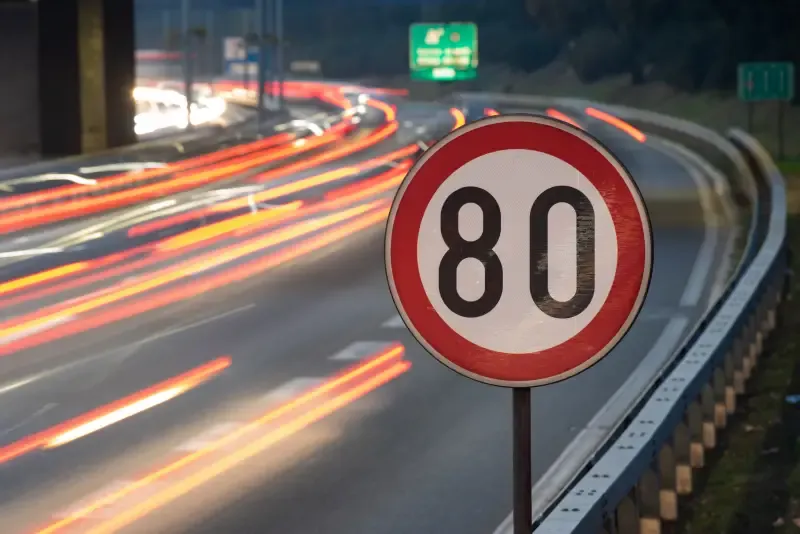
If you’re planning a drive across Europe, getting a handle on the local speed limits is one of the smartest things you can do before you start the engine. Unlike other parts of the world with more uniform rules, Europe is a bit of a patchwork when it comes to traffic laws. Each country sets its own limits and enforcement styles, which can change the moment you cross a border.
This means you might find the legal speed shifting quite a bit, even on roads that look identical to the ones you just left. For travelers, it’s not just a bit confusing—it can be a real risk to your budget. Thanks to modern data-sharing across the EU, speeding fines can easily follow you back home, so staying aware of the signs is definitely worth the effort.
Quick answers – European speed limits
Here’s what every driver needs to know at a glance before hitting European roads:
- No unified system exists – each country sets its own rules, and regional differences (like those between Flanders and Wallonia in Belgium) add further complexity.
- Typical default limits for passenger cars:
- 50 km/h in built-up areas and urban roads
- 80–100 km/h on rural roads and country roads
- 120–140 km/h on motorways and expressways
- Almost all European countries use km/h, not mph – only the United Kingdom still posts limits in miles per hour.
- Germany has motorway sections with no general speed limit, but recommends 130 km/h and maintains many controlled stretches with posted restrictions.
- Fixed and mobile speed cameras are widespread, including average-speed (section control) systems that measure your speed between two points.
- Within the EU, speeding fines can be enforced across borders – rental companies receive notices and bill drivers directly, often with an administrative fee added.
What are the standard speed limits in Europe?
Most European countries break their speed limits down into three main categories: urban areas, rural roads, and motorways. This helps authorities set limits that actually make sense for the environment, whether it's a tight city street or a wide-open highway.
Here’s a rough guide for what to expect when driving a standard car:
- In cities: 50 km/h is the general rule, though you'll see more and more "30 km/h zones" popping up in residential areas, near schools, or in historic centers to keep things safer for pedestrians.
- Rural roads: These usually range from 80 to 100 km/h. Countries like France and Denmark often stick to 80 km/h, while places like Poland, Italy, and Spain typically allow up to 90 km/h.
- Motorways: You’re looking at anywhere from 120 to 140 km/h. While Belgium and Spain stay at 120, France and Italy go up to 130. Poland and Bulgaria have some of the highest limits at 140 km/h.
It’s worth noting that speed really does impact safety; studies show that even a small 5% increase in average speed can jump your risk of an accident by about 10%. That’s why you’ll see those stricter limits in crowded areas.
Also, keep an eye out for variable signs in places like Germany, France, or the Netherlands—they can automatically drop the limit if the weather turns bad or traffic starts to pile up. And if you’re towing a trailer or driving a larger van, remember that you’ll usually be restricted to lower speeds, often around 80 or 90 km/h, even on the fastest motorways.
How do speed limits differ across European countries?
The fact that speed limits vary so much across Europe really comes down to how each country balances things like road quality, environmental goals, and local driving culture. While national governments set the general rules, it’s quite common for local cities or regions to tweak them to fit their specific needs.
Here are a few reasons why things aren't always uniform:
- Different standards: You might find that a rural road in France is capped at 80 km/h, while a very similar road in Germany allows for 100 km/h.
- Regional differences: Some countries have internal variations; for instance, Belgium sometimes sees different approaches between Flanders and Wallonia.
- Signage is king: Regardless of what the general national law says, a posted road sign always takes precedence. If you see a 30 km/h sign, that’s the rule, even if you’re on a main thoroughfare.
For anyone planning a multi-country trip—like the popular Poland–Germany–Czechia routes often taken by Kaizen Rent customers—it’s a smart move to double-check the default rules for each country before you set off. It’s also worth confirming your rental agreement details regarding cross-border travel.
To give you a better idea of how this looks in practice, let’s dive into three specific countries to see how that same city-rural-motorway structure can result in some very different numbers.
What are the speed limits in Germany and how does the Autobahn work?
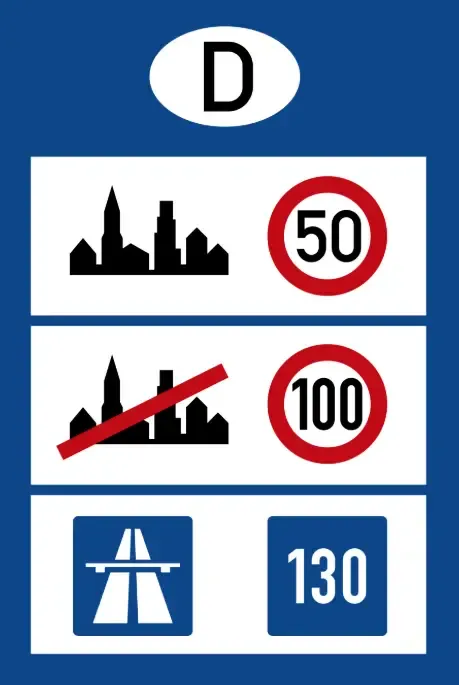
Germany’s speed limit framework for standard passenger cars:
- Urban/built-up areas: 50 km/h (31 mph)
- Rural roads outside built-up areas: 100 km/h (62 mph)
- Autobahn motorways: No single general upper limit on many sections, but with a recommended speed (Richtgeschwindigkeit) of 130 km/h (81 mph)
While the "no limit" sections of the German Autobahn get all the headlines, they actually coexist with a lot of stretches that have very strict limits—usually between 80 km/h and 130 km/h. You’ll mostly see these restrictions near cities, major junctions, construction zones, or in areas where noise and environmental protection are a priority. In fact, current estimates suggest that 50% or more of the entire network is now subject to some kind of permanent or variable limit.
On the unrestricted parts, you’ll definitely see high-performance cars pushing well past 200 km/h, but it’s not the norm for everyone. Most local drivers tend to cruise more comfortably between 130 and 150 km/h. The most important legal rule to keep in mind is that even without a posted limit, you must always be in full control of your car. This means you have to adapt your speed to the traffic, weather, and visibility. If you’re driving at a speed that’s considered "grossly inappropriate" for the conditions, you can still be fined for dangerous driving.
Germany has strict enforcement with very low tolerance thresholds in restricted zones – often just 2–3 km/h above the posted limit. Tourists in rental cars should take posted numbers very seriously on German roads.
What are the speed limits in Spain?
Spain has really stepped up as a leader in urban safety with some of the most significant road reforms in Europe. Since May 2021, most cities have shifted to much lower limits to protect pedestrians and cyclists:
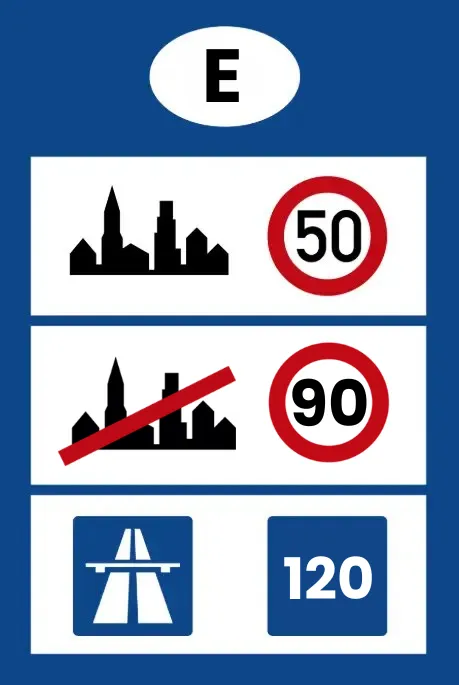
- Urban areas: The standard is now 30 km/h for most single-lane or narrow residential streets. You’ll generally only see the 50 km/h limit on larger, multi-lane boulevards.
- Rural roads: These are typically set at 90 km/h.
- Motorways (Autovías and Autopistas): The maximum is 120 km/h.
Quick mph conversions: 30 km/h ≈ 19 mph, 90 km/h ≈ 56 mph, 120 km/h ≈ 75 mph.
Spain introduced these lower general speed limits specifically to cut pedestrian deaths and serious injuries, with early results showing fewer fatal urban crashes. The Spanish traffic authority DGT uses extensive fixed and mobile speed cameras, and fines for substantial speeding can be high. Points are added for residents, and foreign drivers are tracked via cross-border systems.
If you're picking up a rental car, you’ll need to pay close attention to 30 km/h speed limit signs in town centres and around schools – these lower speed limit zones are now standard rather than exceptional, and many practical details are covered in Kaizen Rent’s rental FAQ.
What are the speed limits in Belgium?
Belgium is a fascinating example of how speed limits can change even without crossing a national border. Because the country is split into distinct regions, the rules on the road shift depending on exactly where you are:
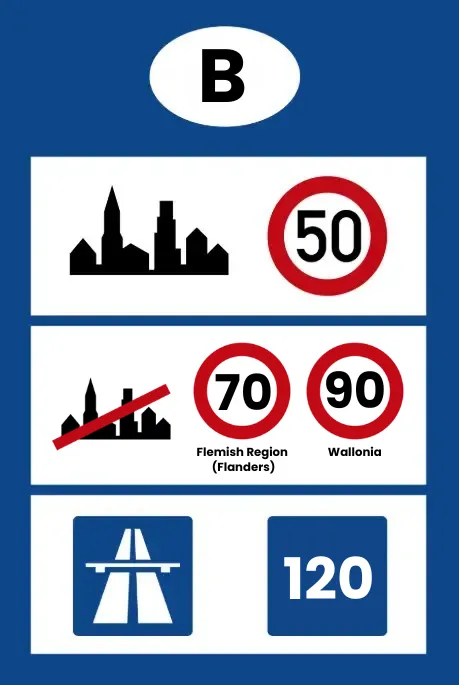
- Urban areas: The national standard is 50 km/h, but there’s a major exception in the Brussels-Capital Region. Since 2021, almost the entire city has been a 30 km/h zone, making it one of the largest slow-speed areas in Europe.
- Rural roads: This is where it gets tricky. In the Flemish Region (Flanders), the limit is 70 km/h, but once you cross into Wallonia, it jumps up to 90 km/h.
- Motorways: These are consistent across the country at 120 km/h for passenger cars.
Because of these regional differences, you really have to pay attention to the signs as you move between the north and the south. Belgium is also big on enforcement—they use a lot of fixed cameras and "average-speed check" zones (where your speed is timed between two points), especially on the busy routes heading into Brussels or Antwerp.
If you’re on a Benelux tour, just remember that a quick drive from Flanders into Wallonia changes the legal rural limit by a full 20 km/h. It’s a good idea to stay alert to the regional markers so you don't accidentally find yourself on the wrong side of a speed camera.
How can you understand European speed limits in mph?
If you're coming from the UK or US, the biggest shift is moving from miles per hour to kilometers per hour. While the UK sticks to mph, the rest of Europe uses km/h for every sign and law.
Key reference conversions:
| km/h | mph (approx.) | Common use |
| 30 | 19 | Urban zones (Spain, Brussels) |
| 50 | 31 | Standard urban limit |
| 80 | 50 | Rural roads (some countries) |
| 90 | 56 | Common rural limit |
| 100 | 62 | Germany rural |
| 120 | 75 | Motorway (Spain, Belgium) |
| 130 | 81 | Motorway (France, Italy) |
|
Quick rule of thumb: To convert from km/h to mph, divide by approximately 1.6 (or multiply by 0.6). For example: 100 km/h ÷ 1.6 ≈ 62 mph. |
The best trick is to set your rental’s digital dash or sat-nav to show both units if the car allows it. It takes the guesswork out of following the signs.
Why do speed limits vary across Europe?
Understanding why speed limits change makes it easier to respect them. It’s not just random—it’s usually a mix of these factors:
- Infrastructure: Countries with wide, modern highways and better drainage often set higher limits than places with older, narrower roads.
- National law and governance: Each government balances safety, travel time and political preferences differently, leading to different default motorway speeds and city policies.
- Safety priorities: There's a big push across Europe to lower urban limits. Research shows that dropping speeds to 30 km/h in cities dramatically cuts pedestrian fatalities.
- Environmental concerns: Speed limits can be lowered to reduce fuel consumption, CO₂ and air pollution. The Netherlands implemented daytime motorway limits of 100 km/h specifically for reducing air pollution and meeting EU air quality standards.
- Local culture: National identity plays a role, too. While Germany keeps its high-speed tradition on the Autobahn, Nordic countries prioritize strict compliance and lower limits.
Even though the EU offers safety advice, every country still makes its own final call. Since there’s no "one-size-fits-all" limit coming anytime soon, the best move is to treat every border crossing as a reset for your driving habits.
How can you drive in Europe without breaking speed rules?
Practical strategies for staying within legal limits:
- Observe roadside speed limit signs – local signs override generic default rules you may have read online or in travel guides.
- Use a modern GPS or smartphone navigation app that shows current speed limits and warns when you exceed them.
- Pay attention to special zones: 30 km/h residential areas, school zones, low-emission urban access zones, and temporary limits around roadworks.
- Beware of average-speed section control systems – driving slowly only just before a camera doesn’t prevent a ticket when your average speed over the entire section exceeds the limit, and in some countries such as Poland recent legal changes have significantly increased speeding penalties.
- Adapt to bad weather conditions even below the posted limit: heavy rain, snow, fog or night driving all justify slowing down. France explicitly reduces motorway limits during adverse weather (130 km/h drops to 110 km/h in rain).
- Plan multi-country trips carefully – print or save a table of each country’s default limits before departure, especially when renting a car for a longer-term European car rental tour.
What happens if you exceed speed limits in Europe?
Consequences vary by country and the degree of excess, but they can be significant
- Penalty scale: Small overspeeds typically result in modest fines, while large violations can trigger very high fines, licence suspensions and even court appearances.
- High-fine jurisdictions: Western and Northern European countries (Switzerland, Norway, the Netherlands) are known for especially severe fines, sometimes calculated as a proportion of income for extreme speeding.
- Enforcement methods: Fixed cameras, mobile speed cameras, unmarked patrol vehicles and section control are all widely used. Tolerance margins are often only 2–5 km/h above the posted limit, and when using short- or medium-term rental cars or vans these violations are easy to trace back to the contract holder.
- Cross-border enforcement: Within the EU, authorities can request vehicle-holder details across borders. If you drive a rental car, the fine is sent to the rental company, which charges the driver plus an administrative handling fee.
- Delayed notifications: Speeding tickets can arrive weeks after a trip, sometimes translated into your language. Don’t assume you “escaped” just because you weren’t stopped roadside.
- Severe consequences: Repeated or very serious offences in countries like France or Italy may result in on-the-spot licence confiscation or temporary driving bans, immediately ending your journey.
For Kaizen Rent customers and other rental car users, violations are particularly straightforward to enforce since rental agreements include driver identification and payment details, which is especially important for visitors renting with a foreign driver’s licence.
FAQ: EU speed limits
Are speed limits the same across Europe?
No, speed limits are not uniform across European countries. Each nation sets its own default limits, and local authorities can introduce their own exceptions. Even when the numbers look similar—like the common 50/90/120 km/h split—the fine print varies widely. You'll find different rules for weather-related reductions, towing trailers, and the increasingly common 30 km/h urban zones.
Because of this, you should check the traffic regulations separately for every country you visit. If you're a business relying on long-term van rentals to move goods across Europe, you need to pay even closer attention, as commercial vehicles often face an entirely different set of country-specific rules and restrictions.
Are European speed limits in mph or km/h?
Almost all of Europe uses kilometres per hour (km/h) on signs and in law. The United Kingdom is the main exception, still using miles per hour (mph). If you're coming from an mph country, the best move is to set your rental car’s digital display to km/h and learn the basic conversions before you hit the road.
Is there really no speed limit in Germany?
Germany has no single nationwide upper limit on all Autobahn sections, but many stretches do have posted limits and a recommended speed of 130 km h is widely observed. Drivers must always choose a safe, controllable speed appropriate to road conditions. Excessive speed in bad weather or in limited zones leads to fines and liability, even if another section of the German motorways is unrestricted.
Can speeding fines follow me home if I rent a car in Europe?
Yes. Thanks to EU data-sharing and agreements between authorities and rental firms, fines issued abroad are routinely passed on to drivers after they return home. When a rental company like Kaizen Rent receives a notice, they identify the driver and typically charge the fine, along with an administrative fee, to the card on file.
How can I quickly check speed limits when driving in an unfamiliar European country?
Combine three methods: watch roadside signs, use a navigation app with up-to-date speed limit data, and check an official overview of national limits before starting your journey. Download offline maps or keep a printed summary of default city/rural/motorway limits for all countries you plan to cross.
Speed limit comparison table for selected European countries
This table provides a simplified overview of basic default limits for passenger cars. Remember that local signs, weather rules and vehicle categories may impose different limits in practice.
|
Country |
City |
Rural |
Motorway |
|
Germany |
50 km/h | 100 km/h | No general limit / 130 km/h recommended |
| Spain | 30–50 km/h | 90 km/h | 120 km/h |
| Belgium | 50 km/h (30 in Brussels) | 70–90 km/h | 120 km/h |
| France | 50 km/h | 80 km/h | 130 km/h (110 in rain) |
| Italy | 50 km/h | 90 km/h | 130 km/h |
| Poland | 50 km/h | 90–100 km/h | 140 km/h |
| Netherlands | 50 km/h | 80–100 km/h | 100 km/h (day) / 130 km/h (night) |
|
Note: Real-world limits may be lower in specific zones including 30 km/h residential areas, construction sites, toll roads with restrictions, and variable speed sections activated during congestion or high temperatures. Heavy goods vehicles, buses and trailers face significantly lower limits regardless of what’s posted for cars. |
See similar articles

Comments (0) Show comments