

International Driving Permit in Poland – can you legally drive with a foreign licence?
Driving in Poland with a foreign licence can be simple, as long as you know the rules that apply to you. Requirements vary depending on where your licence was issued and how long you plan to stay. For many visitors, this is where regulations regarding an international driving permit in Poland become relevant. Read on to make sure you are fully prepared before getting behind the wheel in Poland, to set off on a trip from Kraków to Zakopane, or to the Bieszczady mountains or the Baltic Sea.
In this article, you will learn:
- when you can legally drive in Poland,
- in which situations an IDP is necessary & when a foreign licence is sufficient,
- time limits for driving with a non-Polish driving licence,
- country-specific conditions, including post-Brexit rules,
- driving requirements in Poland,
- key traffic rules for foreign drivers,
- common mistakes made by foreign drivers,
- what to prepare before driving in Poland.
What is an International Driving Permit in Poland and is it recognised in Poland?
An International Driving Permit (IDP) is a document recognised in many countries around the world and allows you to confirm your driving privileges while abroad for a specified period of time. However, it is important to remember that it is not a standalone document entitling you to drive. It must always be used in conjunction with a valid national driving licence, as it is only a supplement and official translation of the latter. This document does not grant new driving privileges – it only confirms those you already have.
What is the procedure for exchanging a foreign driving licence in Poland?
The exchange of a foreign driving licence for a Polish one is carried out on the basis of an application for the exchange of a driving licence. The application, together with the required supporting documents, must be submitted to the transport department responsible for the place of permanent or temporary residence.
In addition to the application and consent to the processing of personal data, you must provide:
- a foreign driving licence and its copy,
- a sworn translation of the driving licence into Polish (prepared or certified by a sworn translator or a competent consul of the Republic of Poland),
- a copy of your identity document (usually a passport),
- a document confirming your right of residence in Poland,
- a colour photograph measuring 3.5 x 4.5 cm.
- a proof of payment of the administrative fee (100.50 PLN).
In addition, in certain cases, in order to complete the exchange of a foreign driving licence for a Polish one, you may be required to pass a state theory driving examination before the Polish licence can be issued.
Can you drive in Poland as a tourist with a foreign licence?
If you’re planning a trip to Poland and wondering whether you can legally drive here as a tourist, the good news is that in many cases this is possible without too much red tape. However, it all depends on where your driving licence is issued and how long you intend to stay in the country. Below you will find a brief overview of the rules — separately for drivers from the European Union and those from outside it.
Can EU and EEA licence holders drive in Poland without limits?
If you hold a driving licence issued in an EU or EFTA country, the situation is straightforward. Your licence is valid in Poland (and in other member states) without the need for any additional formalities.
This means that, as a citizen of an EU or EFTA country, you can come to Poland and use your existing driving licence for its entire period of validity — even if you obtained it abroad.
What rules apply to non-EU driving licences in Poland?
In the case of driving licences issued outside the EU/EEA, the rules are more complex and depend, among other things, on the length of stay and the type of document:
| Validity period | You may drive in Poland for up to six months from the date of your first entry into the country. Once this period has expired, you must obtain a Polish driving licence if you wish to continue driving legally. |
| International Driving Permit (IDP) | It is recommended that you carry your IDP alongside your original licence — particularly if your driving licence is not written in the Latin alphabet or does not meet the standards set out in the Vienna Convention on Road Traffic. The IDP serves as a translation and may be helpful during roadside checks or when dealing with the authorities. |
| Exchange for a Polish driving licence | After six months, you must exchange your foreign driving licence for a Polish one. |
Can you drive in Poland with a US driving licence?
- If you are a US citizen and wish to drive in Poland, you must:
- you must hold an International Driving Permit (IDP) or a Polish driving licence. A US driving licence alone is not sufficient unless you have a document authorising you to drive abroad.
- If you do not wish to obtain a Polish driving licence, you can use an International Driving Permit (IDP) together with your US driving licence. You can use this document for up to 6 months from the date of your arrival in Poland.
However, if you are staying in Poland for longer and wish to continue driving, you will need to:
- pass a theory test in Poland,
- and obtain a Polish driving licence.
Can you drive in Poland with a UK licence after Brexit?
If you hold a driving licence issued in the UK, you can still use it in Poland despite Brexit. The licence is recognised, so you can drive during a tourist or short-term stay without any additional formalities.
Your UK driving licence remains valid in Poland; however, if you decide to settle in Poland permanently, you should exchange it for a Polish licence. The exchange procedure is relatively straightforward and follows the rules applicable to foreign driving licences.
In practice, this means that:
- you can drive freely in Poland on your British driving licence during a temporary stay,
- if you are staying in Poland for a longer period (usually after meeting the residence requirements, e.g. 6 months of legal residence), you should exchange your licence,
- once you have moved to Poland permanently, exchanging your driving licence for a Polish one becomes necessary in order to continue driving legally.
Can you drive in Poland with a Canadian driving licence?
During your holiday in Poland, you may use your Canadian driving licence; however, it is strongly recommended that you also carry an International Driving Permit (IDP). This makes communication easier during roadside checks and is sometimes required by car hire companies.
What are the legal requirements for driving in Poland?
Beyond licence documentation, Poland has specific legal requirements that all drivers must follow. These cover minimum age, mandatory equipment, insurance needs, and document requirements that apply equally to locals and foreign visitors.
What is the minimum driving age in Poland?
The minimum age for driving passenger cars in Poland is 18. These requirements comply with EU Directive 2006/126/EC and apply to all drivers, including those holding an international driving licence.
Age verification is standard practice during police checks and at car hire companies. Importantly, your foreign valid licence must be valid for at least 6 month in order to hire a car – this ensures that drivers have sufficient experience to navigate unfamiliar roads.
At Kaizen Rent, our services are aimed at young drivers, who are increasingly opting to hire cars for short or long periods. That’s why you can hire a car from us from the age of 18.
Below is a table of fees and car availability for young drivers:
| Driver’s age | Additional charge | Rental restrictions |
| 18–23 years | ‘Young driver’ surcharge (29.99 PLN/day) | Most cars available for hire, excluding premium models |
| 24–25 years | No charge | Access to standard cars, excluding premium models |
| 25+ years | No charge | Full access, including premium cars |
And if you’re just starting out with car hire and wondering how it all works, take a look at our article 👉How to Rent a Car in Poland – Ultimate Guide.
What documents must you carry while driving in Poland?
Polish law requires you to carry the following documents while driving:
- Valid licence (your national licence)
- International driving permit (if required for your country)
- Passport or national ID card
- Vehicle registration documents, if the car you arrived in is registered in your home country.
- Insurance certificate (green card for non-EU vehicles)
What traffic rules should foreign drivers know in Poland?
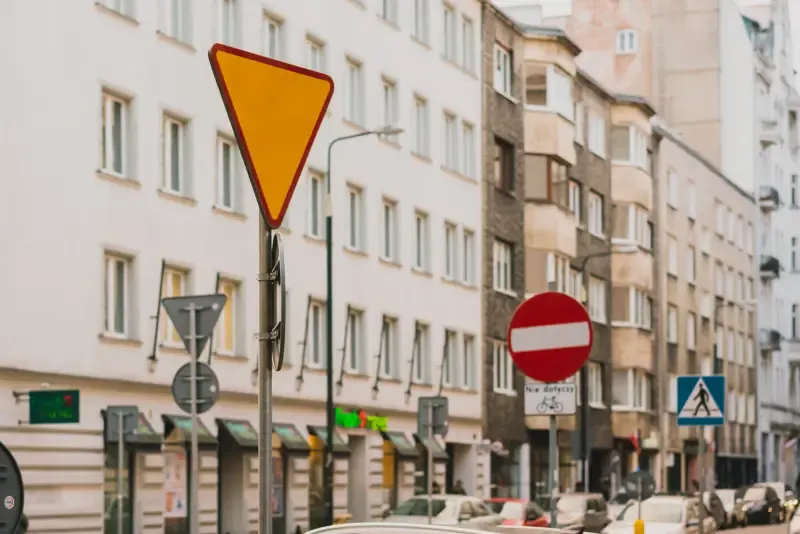
Driving in Poland may seem straightforward at first, as the country follows right-hand traffic like most of Europe. However, some local rules and regulations differ from what tourists might expect in other countries. Familiarizing yourself with Polish traffic laws before getting behind the wheel is essential for a safe and stress-free journey.
What practical tips help foreign drivers avoid problems in Poland?
Driving in Poland can seem like a challenge for foreign drivers, especially if they are unfamiliar with local traffic laws and customs. Although Polish roads are generally safe, it is worth being prepared for specific restrictions and road signs, as well as knowing which emergency numbers are essential in the event of any problems. Below are some practical tips to help you avoid unpleasant situations and ensure your journey through Poland is comfortable and safe.
- Keep an eye on road signs and road conditions – in smaller towns and on local roads, you may encounter potholes, narrow sections or uneven surfaces.
- Refuelling and fuel – most petrol stations accept international cards, but in small towns it’s best to carry cash or check whether the station is open 24/7.
- Offline navigation – mobile network coverage in some areas, such as in the mountains or the countryside, may be limited. It is worth having offline maps on your phone or GPS.
- Parking in city centres – some spaces require you to pay for a ticket at a machine or via a mobile app; failure to pay may result in a fine or your vehicle being towed away.
- LPG refuelling and different fuel types – LPG stations are common in Poland, and fuels are labelled as follows: Pb95, Pb98, ON (diesel). Check which one is suitable for your car. In a car hired from Kaizen Rent, information on the fuel type can be found on a sticker located near the fuel tank.
- Weather and natural conditions – fog, snow or rain can significantly reduce visibility. In the mountains, watch out for sharp bends and narrow roads.
- Emergency numbers and breakdown services – as well as 112 (general), 997 (police), 998 (fire brigade) and 999 (ambulance service), it’s a good idea to have the number for your local breakdown service to hand.
- Driving culture – Polish drivers can be impatient, especially in traffic jams; it’s best to stay calm and avoid reacting aggressively.
- Tolls – some sections of motorway require the eTOLL(toll payments) system or electronic payment; check before you travel to ensure that your chosen route does not include any toll sections
Rental car in Poland with Kaizen Rent – simple, convenient and stress-free
Knowing the rules is one thing, but having a reliable vehicle is just as important. This is where Kaizen Rent comes in, offering a wide range of modern cars, SUVs and vans across Poland, with convenient pick-up points not only at the major airports but also in the largest cities.
Hiring a car is child's play – there are several convenient ways to do it:
- Easy online booking – transparent prices and a 5% discount when paying online.
- Via the form on the website: www.kaizenrent.pl/en
- By phone on: +48 76 727 99 99
- By email: [email protected]
Summary: Essential guide to driving in Poland
Planning a road trip in Poland? If you have a driving licence from another country, check whether you need an international driving permit. EU and EFTA countries licences are usually enough, but visitors from the US Canada need an international driving licence.
Follow Poland road rules: know road signs, traffic lights (red light, green light), speed limits (km/h), pedestrian crossings, railway crossings, and other road users. Always wear seat belts, use a child car seat, and keep a warning triangle, fire extinguisher in rented cars. Mobile phones are only hands-free.
Watch for speed cameras, traffic jams, illegal parking, and toll roads. Use dipped headlights, respect bus stops and tram stops, and follow local rules in major cities, small towns, and rural areas. With a valid licence, international driving permit, and knowledge of traffic rules, your Poland road trip and trips to other European countries will be safe and enjoyable!
FAQ – driving in Poland as a tourist
Is an International Driving Permit valid in Poland without a national driving licence?
No. An International Driving Permit (IDP) is not valid in Poland without a national driving licence.
Why?
An IDP is only a translation of your national driving licence and is not a separate document entitling you to drive. This means that:
- ✔️ You must have your valid national driving licence with you.
- ✔️ An IDP is only valid together with your national driving licence.
- ❌ An IDP alone, without your national driving licence, is invalid.
How long can I drive in Poland with a foreign driving licence?
If you have a foreign driving licence and are in Poland, the rule is quite simple:
- Are you here for a short time (tourist, business trip, a few months)?
You can drive normally with your driving licence, as long as it is valid. Sometimes you also need an International Driving Permit (IDP), especially if the document is not from the EU.
- Do you live in Poland permanently?
In Poland, it is assumed that after 185 days of stay, you are considered a resident.
And that's when the differences begin:
- Driving licence from the EU / EEA / Switzerland – you can continue to drive without any problems, you do not need to exchange it (unless you want to have a Polish one).
- Driving licence from outside the EU – after 185 days, you must exchange it for a Polish one. Depending on the country, a theory test may sometimes be required.
Can I drive in Poland with a US licence without an International Driving Permit?
If you are from the US and plan to drive in Poland, it is best to have either a Polish driving licence or an International Driving Permit (IDP).
An American driving licence alone, without an IDP, is not sufficient.
The good news is that an IDP is valid in Poland for the first six months after your arrival, so as a tourist or short-term visitor, you can drive without any problems.
Can I drive in Poland as a tourist without exchanging my driving licence?
Yes, tourists do not need to exchange their licence for a Polish driving licence during short visits. The time limits described above apply, after which licence exchange through Polish driving authorities becomes necessary if you plan to continue driving.
Do I need a certified translation of my driving licence in Poland?
The international driving permit serves as the official translation recognised in Poland. A separate certified translation is not legally required if you have a valid IDP. However, some rental agencies may request a sworn Polish translation (costing 100+PLN) for licences from less common countries.
Can I rent a car in Poland with a foreign driving licence?
At Kaizen Rent, a car can be hired by a driver who is at least 18 years old and has held a driving licence for at least six months. However, if you are under 23, you are required to purchase the “Young Driver” package.
What happens if I drive in Poland without the required documents?
Penalties include fines from 50 PLN to 1,500 PLN depending on which documents are missing. Vehicle impoundment can occur in serious cases, costing 500 PLN or more for recovery. Your insurance coverage may be invalidated, leaving you personally liable for any accident costs. Repeat violations can lead to more serious legal consequences.
Can the police stop me for a document check in Poland?
Yes, Polish police have authority to conduct random document checks on any vehicle at any time. These stops are routine and don’t require probable cause. Cooperate calmly, present all required documents, and keep them in an easily accessible location. Foreign drivers experience these checks frequently, particularly on highways and near tourist areas.
See similar articles

Comments (0) Show comments