
Driving in Poland as a tourist – speed limits, alcohol rules and road basics
Driving in Poland gives you the freedom to explore at your own pace – from the cobbled streets of the top 6 cities in Poland for a perfect city break, like Krakow and Gdańsk, to the must-see mountains in Poland at the towering peaks of Tatra National Park, and the ancient forests of Białowieża. Instead of relying on public transport timetables, having your own car in Poland means you can stop at that roadside restaurant, take a detour through a sleepy village, visit castles in Poland that will take you back in time, or follow the sunset over by the lakes included in Masurian Lakes Poland: Ultimate Trip Guide. You can even explore the sandy beaches along the coast with the help of Baltic Sea Poland: Ultimate Trip Guide– all without worrying about the last train home.
Driving in Poland: what you’ll learn in this article?
In this article, we will help you find answers to frequently asked questions, to ensure that your journey in Poland proceeds safely and in accordance with the applicable traffic regulations:
-
What is it like to drive a car in Poland as a tourist?
-
What are the driving requirements for foreigners?
-
Which side of the road do you drive on in Poland and is it right-hand traffic?
-
What are the speed limits on different types of roads?
-
How to correctly read Polish road signs
-
What is the blood alcohol limit
-
How toll roads work and how to pay for them
Further on in the article, we will expand on these issues step by step, showing that driving in Poland can be both safe and enjoyable – as long as you prepare well for your trip.
Let’s begin with the basics...
What are the driving in Poland requirements for foreign drivers?
Your driving in Poland requirements depend largely on where your driving licence was issued.
EU and EEA licence holders can drive in Poland using their valid national photocard driving licence for typical tourist stays. There’s no need for an international driving licence or additional paperwork – just bring your licence and you’re set.
UK licence holders are also generally accepted post-Brexit for short visits under bilateral agreements. You don’t typically need an international driving permit for stays under 90 days, but it’s wise to check the latest guidance from both the UK FCDO and Polish authorities before you travel, as rules can evolve.
Non-EU drivers – including those from the USA, Canada, Australia, and many Asian and Latin American countries – may need an international driving permit alongside their domestic driver’s licence. This is particularly important if you’re renting a car, as most rental companies require the IDP as a matter of policy. The IDP acts as a translation of your licence and is issued by motoring organisations like the AAA or AA in your home country.
When driving in Poland, always carry:
-
Your passport or national ID
-
Your driving licence (and IDP if required)
To learn more about using a foreign driving licence in Poland, please read our article: ‘International Driving Permit in Poland – can you legally drive with a foreign licence?’.
Driving in Poland – rules you have to follow
After familiarising yourself with the basic rules of driving in Poland, it is also worth learning a few less obvious rules that help to maintain safety and smooth traffic flow. Although they may seem trivial, compliance with them is mandatory and often strictly enforced. Below are the most important of these additional rules.
Additional traffic rules in Poland
-
Zipper merging
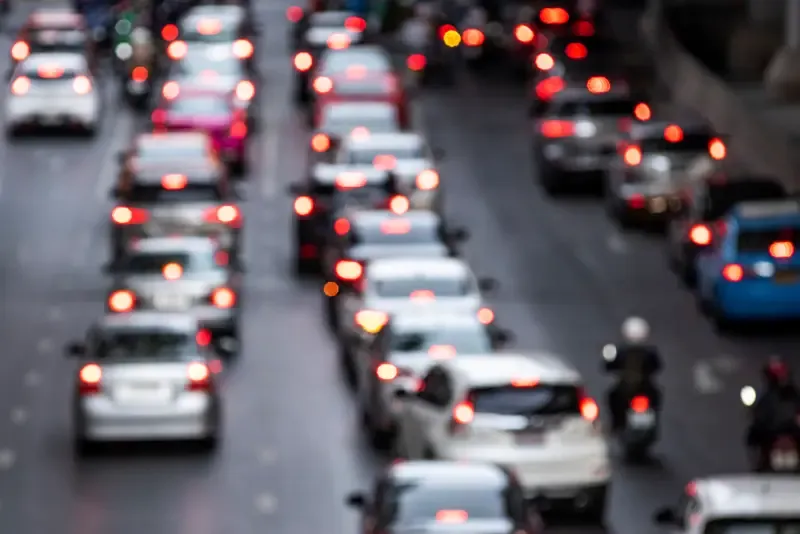
In the event of a road narrowing or a lane ending, drivers are required to use the so-called zipper merging technique. This involves vehicles from the ending lane entering the continuing lane one at a time, while other drivers allow them to enter. This rule increases traffic flow and reduces traffic jams.
-
Emergency corridor for emergency services
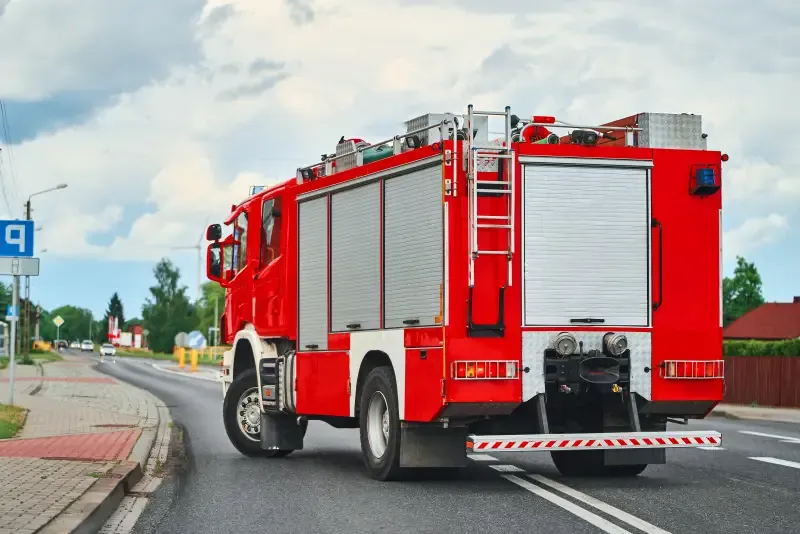
On multi-lane roads, drivers are required to create a free space to allow emergency vehicles to pass. Usually, cars in the left lane move as far left as possible, and cars in the other lanes move to the right, creating a ‘corridor of life’. This behaviour can save valuable time for emergency services.
-
Right-hand rule
At equal-priority intersections, i.e. without signs indicating right of way and without traffic lights, vehicles approaching from the right have right of way.
-
Obligation to stop at a green conditional arrow
A green conditional arrow at a traffic light allows you to turn right even if the main light is red. However, before turning, you must come to a complete stop and yield to pedestrians and other vehicles. Failure to give way to pedestrians or other vehicles in this situation may result in a fine.
-
Use the horn only in justified situations
In Poland, the horn should only be used to warn of danger in traffic. This means that the horn should only be used to prevent a potential collision or to alert another road user to a hazard.
-
Prohibition on using a mobile phone without a hands-free kit
In Poland, drivers are not allowed to use a phone in a way that requires holding it in their hand while driving. This means that it is prohibited not only to make calls, but also to write messages, browse applications or operate navigation if the phone is in your hand. In 2026, these regulations were tightened, and holding a phone in your hand while driving is punishable by: a fine of 500 PLN and as many as 12 penalty points, which is half the limit for an experienced Polish driver.
On which side of the road do you drive in Poland?
Poland drives on the right-hand side of the road, with vehicles having the steering wheel on the left. If you’re from the UK, Ireland, Cyprus, or Malta, this will feel different at first – but most drivers adapt within an hour or two.
The main adjustments involve:
-
Roundabouts: Remember that traffic flows anticlockwise, and vehicles already on the roundabout have priority. Signal right when you’re about to exit
-
Joining major roads: Take extra care when pulling out, as your instinct may be to look the wrong way first
-
Overtaking: You’ll pass other traffic on their left side
For anyone wondering “does Poland drive on the left or right?” – the answer is firmly right, just like Germany, France, Spain, and most of continental Europe. Hiring a rental car from Kaizen Rent means you’ll be driving a left-hand-drive vehicle designed for Polish roads, which most visitors find more intuitive than bringing a right-hand-drive car from the UK.
If you would like more detailed information, take a look at our article: International Driving Permit in Poland – can you legally drive with a foreign licence?
What are the speed limits in Poland?
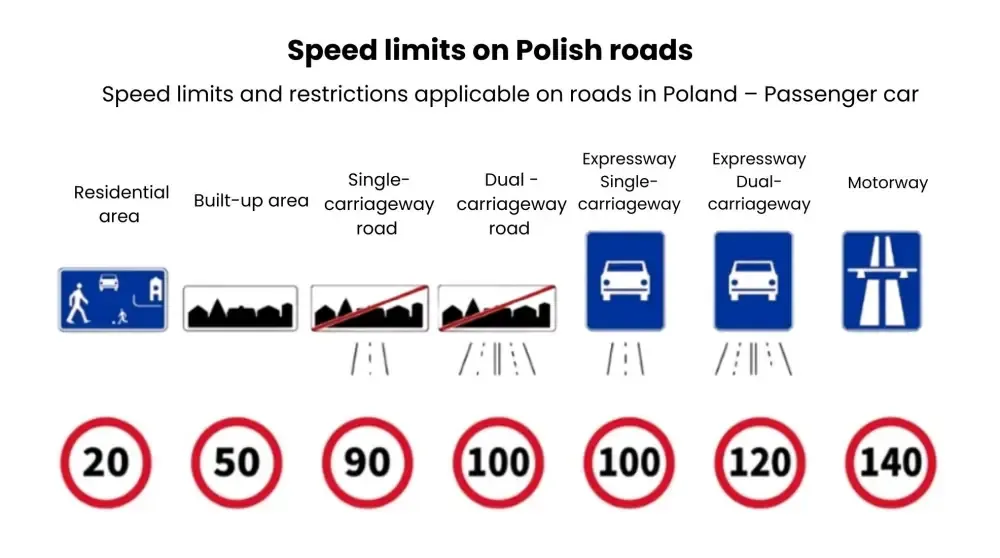
In Poland, speed limits are measured in kilometres per hour, and exceeding them, especially in built-up areas, can result in heavy fines and may lead to your driving licence being suspended. From March 2026, exceeding the speed limit by more than 50 km/h will result in an automatic three-month driving licence suspension, not only in built-up areas, but also on single carriageway roads outside towns.
Here’s a quick reference:
Local traffic signs always override standard speed limits. Temporary lower limits are common near schools (often 30 km/h), roadworks, and villages – sometimes dropping without much warning. Keep your eyes on the signs, not just your satnav.
Poland has an extensive network of fixed speed cameras, mobile police units, and average-speed sections. Navigation apps often warn about limits and camera locations, but drivers remain legally responsible for their speed. Speed traps are particularly common at the entrance to urban areas where limits drop suddenly.
One thing most drivers notice quickly: other drivers often exceed limits, especially on dual carriageways and motorways. This doesn’t mean you should. Fines start at 50 PLN for minor infractions but escalate rapidly – exceeding by 50 km/h in built-up and non-built-up areas results in mandatory suspension of the driving licence for 3 months. The driver will also receive a fine of at least 1,500 PLN (3,000 PLN for repeat offenders) and 13-15 penalty points.
How do Poland road signs differ from other countries?
Poland follows European conventions for road signs, so if you’ve driven in Germany, Czechia, or France, many Polish road signs will look familiar. The main difference is that text appears in Polish.
Warning signs In Poland, warning signs (e.g. dangerous bend, pedestrian crossing) have a yellow background. In most European countries (e.g. Germany, France), the background is white. The yellow colour in Poland is intended to increase visibility, especially in low light conditions.
Regulatory signs are circular. Red circles indicate prohibitions (no entry, no overtaking), while blue circles show mandatory instructions (minimum speed, direction of travel).
Motorway signs are green, national roads often use red backgrounds and regional roads may be marked in blue. Key Polish terms you’ll see include:
-
Autostrada – motorway (A roads)
-
Droga ekspresowa – expressway (S roads)
-
Płatna – toll
-
Objazd – diversion/detour
-
Centrum – city centre
Some unique signs exist near military bases (tank or heavy vehicle warnings), but these are rare on typical tourist routes.
What is the drink drive limit in Poland?
Poland has one of Europe’s strictest drink drive limits: a maximum blood alcohol concentration (BAC) of just 0.02%. To put that in perspective, the UK allows 0.08% and most Western European countries permit 0.05%.
What does 0.02% mean in practice? It’s so low that even a single small drink could push you over. Many people metabolise alcohol at roughly 0.01–0.02% per hour, meaning that drinking late the night before could still leave you over the limit the next morning.
Penalties are severe:
-
BAC 0.02–0.05%: Misdemeanour, fines from 500–5,000 PLN, 10 penalty points, licence ban of 6–36 months
-
BAC over 0.05%: Criminal offence, fines up to 30,000 PLN, licence ban of 3+ years, potential imprisonment
-
BAC of 0.15% (1.5 promille) or higher: From 2026, the court will be obliged to order the forfeiture (confiscation) of the vehicle if the driver's blood alcohol content is at least 1.5 per mille (0.15% BAC). What is particularly important for tourists and people using rental cars: if the vehicle is not the sole property of the offender, the court will order a fine equivalent to the value of the vehicle, ranging from 5,000 PLN to 500,000 PLN instead of confiscation
Polish police carry out random roadside breath tests and mandatory testing after any crash. They can test any driver at any time without needing prior suspicion.
The safest approach for tourists? Avoid driving after any alcohol at all. If you’ve had a few drinks the evening before, consider waiting until late morning or using public transport. Driving under the influence in Poland is taken extremely seriously and the consequences can derail your entire trip.
If you are unsure about your blood alcohol level, you can go to the nearest police station near your location. In many cases, free breathalysers are available in waiting rooms, allowing you to check whether you can safely drive on Polish roads.
What do Poland car seat laws require?
Polish regulations concerning car seats comply with EU standards and are strictly enforced during roadside checks. Children under 150 cm in height (approximately 12 years old, although this age may vary) must travel in an appropriate child seat or other restraint device that is adjusted to their weight and size. Car seats must comply with EU safety standards (R44/04 or the newer i-Size R129 regulation).
Children over 135 cm tall may travel in the back seat with standard seat belts instead of a car seat, provided they weigh more than 36 kg. It is strictly forbidden to transport a child under three years of age in a vehicle without a seatbelt and an appropriate car seat.
Key rules:
-
A rear-facing child seat must not be placed in the front passenger seat with an active airbag – in this case, the airbag must be deactivated beforehand
-
Children taller than 150 cm may use standard adult seat belts, which must be fastened at all times
-
Penalties for non-compliance are approximately 300 PLN
Practical tip for tourists:
If you are flying to Poland and do not want to bring large child seats with you, Kaizen Rent can provide suitable seats and booster seats as part of your car rental. Simply indicate your need for a child seat when making your booking at www.kaizenrent.pl/en to ensure that the car is equipped with a car seat suitable for your child's weight and height.
Are there toll roads in Poland, and how do you pay?
Not all roads in Poland are toll roads. Let's start with the fact that most motorways in Poland are free of charge. Tolls mainly apply to certain sections of motorways – specifically parts of the A1, A2 and A4 – while most expressways (S) and national roads are free. Vehicles with a maximum permissible weight (MPW) of over 3.5 tonnes, such as lorries, trucks and coaches, are charged using the e-TOLL system.
Main toll sections include:
-
A1: Gdańsk to Toruń (approximately 100 km) - Driving the entire toll section of the A1 motorway costs 29.90 PLN
-
A2: Świecko (German border) to Konin (approximately 300 km), Konin to Stryków. - Usually, a toll of 120 PLN is charged for driving the entire section of the A2 motorway (Świecko-Konin) in a passenger car. In the case of the A2 section (Konin - Stryków), the cost of travel for a passenger car is approximately 52 PLN
-
A4: Kraków to Katowice (approximately 60 km). - A journey on this section of the A4 motorway costs 34 PLN one way. However, the concession for this section is only valid until 2026
Payment methods:
|
Toll collection system |
Description |
|
Manual gates |
The driver stops the vehicle at the gate and makes a payment in cash or by card. You can typically pay at traditional toll plazas using cash (PLN, EUR, USD) or major credit/debit cards. |
|
The state-run e-TOLL system |
An electronic toll collection system using GPS technology. It requires vehicle registration and the use of an app or on-board device. |
|
Videotolling (e.g. Autopay) |
Fees are collected automatically through number plate recognition, without the need to stop the vehicle. |
How to prepare for travelling on a toll motorway
-
Install a payment app – Applications such as AmberOne, Autopay, SkyCash or e-TOLL allow you to pay motorway tolls automatically, so you can pass through toll points without stopping. Keep in mind that not all sections of the A2 motorway support app payments, so it is worth checking the details before starting your journey.
-
Bring cash or a payment card – If you prefer a traditional payment method, make sure you have enough cash or a valid bank card with you to pay the toll at the gate.
Can I drive through Poland without using toll roads?
Yes, you can absolutely plan routes that avoid Polish toll roads, though your journey may take longer.
Most navigation apps and in-car GPS units offer a “no tolls” option, which routes you along national roads (DK) and regional roads (DW) instead of paid motorway sections. These alternatives can add 20–50% to your travel time but offer their own rewards: scenic villages, roadside restaurants, and a slower pace that lets you see more of the country.
For example, driving Warsaw to Gdańsk via toll roads takes about 4 hours; the toll-free route via rural roads might take 5–5.5 hours but passes through charming towns you’d otherwise miss.
Practical considerations:
-
Lower speed limits apply (typically 90 km/h maximum outside built-up areas)
-
Expect more heavy traffic from lorries, plus pedestrian crossings and tractors
-
Petrol stations may be more widely spaced than on motorways – fill up before long stretches
-
These routes are more affected by traffic jams in towns during rush hours
For tight schedules – say, Wrocław to Kraków in a single day – using the toll sections is usually worth the small extra cost. For leisurely road trips, going toll-free lets you discover Poland’s quieter corners.
Is it safe to drive in Poland?
Driving in Poland is generally safe for tourists who follow the rules of the road. Road safety has improved significantly over the last decade. The average number of road deaths in the EU in 2024 was 45 per million inhabitants, whereas in Poland it was 52 per million inhabitants, which is slightly above the EU average.
Challenges to be aware of:
-
Other drivers can be impatient: Tailgating and aggressive overtaking are more common than in the UK or Scandinavia, especially on single carriageways
-
Speed changes come quickly: Limits can drop suddenly when entering villages or urban areas
-
Winter conditions (November–March): Snow, ice, and reduced visibility are common, particularly in mountainous regions and eastern Poland
Driving tips for safe driving:
-
Maintain a safe following distance (at least 2 seconds at motorway speeds)
-
Don’t compete with aggressive overtakes – let them pass
-
Slow early for villages, pedestrian crossings, and school zones
-
Use winter or all-season tyres with certification between November and March (Kaizen Rent provides these as standard during colder months)
Theft from parked cars is relatively uncommon on tourist routes, but don’t leave valuables visible. In city centre locations, use secure car parks where possible – paid parking is widely available and usually well-supervised.
Is it easy to drive in Poland as a foreigner?
Most visitors find driving in Poland straightforward once they’ve adjusted to metric speed limits and right-hand driving. The learning curve is typically just a day or two.
What makes it easy:
-
Clear signage on major roads, with international symbols and increasing use of English on tourist routes
-
Good road quality between major cities like Warsaw, Poznań, Gdańsk, Łódź, and Kraków
-
Abundant petrol stations (Orlen, Shell, BP, Circle K) with competitive fuel prices (roughly 6–7 PLN per litre)
-
Free parking available in smaller towns especially at weekends; parking meters or paid parking apps in larger cities
Typical “culture shocks” for foreigners:
-
Higher average speeds than you might expect
-
Closer following distances – Polish drivers often sit right behind you
-
Frequent overtaking on single carriageways, sometimes in situations that feel risky
-
Rush hour heavy traffic in major cities (roughly 07:00–09:30 and 15:30–19:00)
Making it easier:
-
Start with shorter journeys to build confidence
-
Avoid peak city rush hours when possible
-
Use navigation apps with live traffic to dodge traffic jams
-
Consider renting a modern car with automatic transmission if you’re not used to driving a manual on the “wrong” side
-
Consider renting a safe and modern car with mandatory equipment inside (warning triangle and fire extinguisher) from Kaizen Rent car rental.
Driving in Poland with a rental car from Kaizen Rent
Now that you understand the driving rules in Poland, you might be wondering about the practicalities of renting a car. That’s where Kaizen Rent comes in. Our How to Rent a Car in Poland – Ultimate Guide walks you through everything from choosing the right vehicle to understanding local insurance requirements, ensuring a smooth and stress-free driving experience across Poland.
Kaizen Rent offers a wide fleet of modern passenger cars, SUVs, and vans across Poland, with convenient pick-up locations not only at major airports – including car rental Warsaw airport, car rental Kraków Balice, car rental Gdańsk Rebiechowo, car rental Wrocław Strachowice, and car rental Katowice Pyrzowice airport – but also in the largest cities across the country. Whether you need a compact car for city streets, a comfortable estate for a family road trip, or a van for a group adventure, Kaizen Rent has a vehicle to suit every traveler’s needs.
Flexible options for every traveller:
-
Short-term rental – daily rentals for city breaks and weekend getaways
-
Monthly car rental – weekly and monthly rentals for extended exploration
-
Long-term car rental – ideal for business travellers needing vehicles for longer periods
-
Replacement cars from insurance (OC) after accidents
Ready to hit the road? Book a car with Kaizen Rent and explore Poland at your own pace – with confidence and comfort.
Summary of essential driving rules in Poland
If you are planning a trip around Poland and are afraid of driving, there is really nothing to worry about. The rules are simple – drive on the right, wear seat belts, and keep your lights on. Motorways are sometimes toll roads, but you can always take side roads and enjoy the views – there are additional points of interest on the map. In general, it is safe and comfortable and a car rented from Kaizen Rent gives you a lot of freedom to explore.
FAQ – Driving in Poland as a tourist
Can I drive in Poland with my foreign driving licence?
To legally drive in Poland, visitors must be aged 18 or over and hold a full, valid driving licence. Visitors from the EU/EEA and the UK can usually drive in Poland with their valid photocard driving licence for short tourist stays, and no additional permits are required.
Drivers from outside the EU or EEA may require an International Driving Permit (IDP) to drive in Poland. This permit serves as a translation of your domestic licence and is often mandatory when renting a car. Please note that the IDP does not replace your original licence and you must carry both documents while driving in Poland. Many car rental companies will request an IDP from drivers with licences issued outside the EU or EEA, in order to comply with local regulations.
If a foreign driver is staying in Poland for more than six months, they may need to exchange their licence for a Polish one depending on their home country's agreements.
Before travelling, check the current guidance of the Polish government and your home country (UK FCDO, US State Department, etc.), as recognition agreements can change.
Can I pay fines in Poland as a foreign driver?
If Polish police issue a fine on the spot, foreign drivers are typically asked to pay immediately by card or cash.
In the case of offences detected by cameras (speeding, running a red light), the fine is sent to the registered owner, and if you rented the car from Kaizen Rent, we will notify you of this situation by email and ask you to transfer the amount due to the specified bank account number.
Can I drink alcohol the day before driving in Poland?
Because the Poland drink drive limit is only 0.02% BAC, even moderate drinking late the previous evening can leave you over the limit the next morning. Alcohol metabolises at roughly 0.01–0.02% per hour, so several drinks at dinner could still register on a morning breath test.
A cautious rule of thumb: if you’ve had more than a small amount of alcohol, consider leaving the car parked until late morning or using public transport.
The safest choice, especially on a short trip, is to avoid mixing alcohol and driving altogether.
Are speed cameras common on Polish roads?
Yes, fixed speed cameras, average-speed sections, and mobile police checks are all common in Poland. You’ll find them particularly at the entrances to built-up areas, near schools, and on national roads.
Can I use navigation apps while driving in Poland?
Yes, you can legally use navigation apps. However, remember that your phone with navigation should be placed in a holder (on the windscreen or air vent grille), on the dashboard, or you should use Android Auto/Apple CarPlay on the car's screen. In Poland, holding your phone in your hand with navigation turned on is against the law.
What are the costs associated with driving in Poland?
When planning your trip, it's helpful to understand the typical costs involved in driving in Poland:
- Fuel prices: Unleaded petrol, diesel and LPG are widely available throughout Poland. Prices fluctuate, averaging around 5–7 PLN per litre depending on the type of petrol station and the fuel type. Fuel stations are common in towns and along motorways, with many open 24/7.
- Tolls: Some motorways in Poland, particularly major routes such as the A1, A2 and A4, have tolls. The cost of tolls depends on the type of road, the distance travelled and the vehicle's emissions category. Payment can be made at toll booths using cash or card, or electronically via apps such as e-Toll.
- Parking fees: Parking regulations are strictly enforced, particularly in city centres. Paid parking zones often operate during the week, with fees typically ranging from 4 PLN to 8 PLN (approximately $1–2 or €0.90–1.60) per hour in major cities and lower fees in less central areas. There are many supervised car parks available in Polish cities, and charges vary.
See similar articles
Comments (0) Show comments